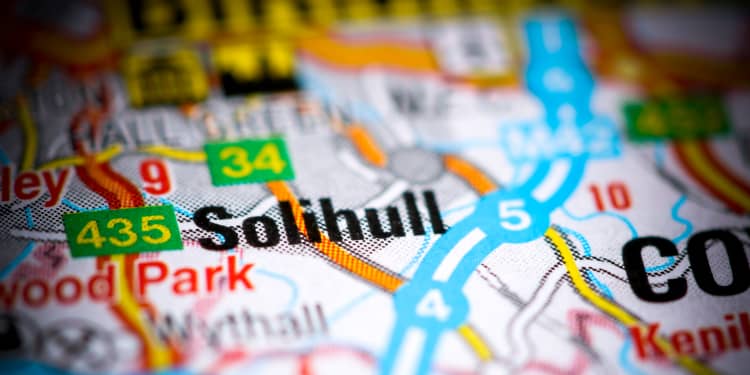
Solihull Area Guide: A Concise Overview for Buyers
By Calum Partridge | Created on 14th May 2026
Hoping to move to Solihull but not sure what to expect? We can help.
Sitting roughly nine miles southeast of Birmingham city centre, Solihull is one of the most desirable places to live in the West Midlands – so it’s a wise option for many potential buyers looking for a long term home.
The town has its origins as a 12th-century market settlement, now functioning as a busy, diverse borough of about 225,000 people. About three-quarters of the borough sits within the green belt, which is why the council often describes Solihull as a “Town in the Country.” Whether you’re a first-time buyer looking at a flat near Solihull station, or a family looking for a home in the catchment area of Tudor Grange Academy – there’s no doubt Solihull has something for you.
This guide covers a few key details about Solihull to help you make a buying decision, including the property market, transport, schools, shopping and more.
Why live in Solihull?
Several reasons come to mind. Schools tend to top the list, with several state secondaries that consistently outperform regional averages. Commuter access is the second draw, since the M42 sits on the eastern edge of the town and direct trains run into Birmingham Moor Street in roughly 8 to 10 minutes. Then there’s the green belt that keeps a sizeable proportion of the borough in unspoilt countryside. So, you can be in the centre of town one moment and walking the towpath of the Stratford-upon-Avon Canal twenty minutes later.
The town itself has a pedestrianised High Street that’s been car-free since 1994, plus the Touchwood shopping centre opened by Queen Elizabeth II in 2002. Around them sit listed buildings going back to the 16th century, including the timber-framed Manor House from around 1495 and the George Hotel, both a short walk from the church of St. Alphege.
The Solihull property market
Solihull’s housing market has held up better than many parts of the country. While different house price authories provide a range of figures, all indicate a stable, well established market. Accordingly, the ONS Local Housing Data states that the average house price in Solihull was around £328,000 in February 2026. Rightmove’s sold-price tracker puts the average closer to £402,515 across all property types over the past 12 months, while Zoopla records an average sold price of £372,035 over the same period. The gap between the figures comes down to sampling, but the direction is the same: stable prices, with detached homes pulling the overall figure higher.
Here’s a quick breakdown of the market by property type, drawing on Rightmove’s most recent figures.
Property type
Average sold price (last 12 months)
Detached
£723,084
Semi-detached
£370,546
Flats and apartments
£208,628
Overall average
£402,515
The average rent in Solihull was £1,258 per month in March 2026, broadly flat year on year. Premium streets like Lovelace Avenue, Alderbrook Road, Streetsbrook Road, and Hampton Lane tend to sit above these averages. If you’d like a steer on the value of a specific property, Partridge Homes offers a free sales or rental valuation.
Transport in Solihull
Solihull is very well served by road, rail, and air links. Here’s what it’s got to offer:
Rail.Solihull station sits on the Chiltern Main Line and runs frequent services to Birmingham Moor Street in around eight to ten mins, and to London Marylebone in roughly 75 to 95 minutes depending on the service. Other stations in the borough include Olton, Widney Manor, Dorridge, and Hampton-in-Arden.
Road. The M42 motorway loops around the eastern side of Solihull, with junctions 4, 5, and 6 all close to town. From there, the M40 takes you down to Oxford and London, while the M6 heads north.
Air. Birmingham Airport sits roughly five miles to the east. Direct trains from Birmingham International station run into Solihull in about eight minutes.
HS2 Interchange. A new high-speed station, HS2 Interchange, is being built at Arden Cross between the M42, A45 and A452. Planned journey time to London is around 35 mins, with full opening now expected toward the end of the decade.
Bus services run regularly along the A34 Stratford Road through Shirley and into Solihull town centre, and National Express West Midlands operates routes connecting most parts of the borough.
Schools and education
Schools are one of the main reasons people pay a premium to live in Solihull. Several state secondaries in the borough consistently rank near the top of the West Midlands. Tudor Grange Academy on Dingle Lane is the best known, founded as a grammar school in 1957 and now teaching around 1,700 pupils. Arden Academy in Knowle, Alderbrook School in central Solihull, and St Peter’s Catholic School are also widely chosen by families. You can browse the council’s full directory of secondary schools in Solihull on its website.
The independent sector includes Solihull School, an HMC co-educational day school dating back to 1560, and Eversfield Preparatory School. Catchment-area pricing is a real factor here, so it’s worth doing your homework on admissions criteria before settling on a street.
Local amenities and shopping
The town centre is covered by two different ‘oases’ of shopping and retail. Touchwood is the larger of the two, and opened in 2002 with a flagship John Lewis, Marks & Spencer, Next, Apple, Waterstones, a Cineworld cinema, and roughly 80 shops in total. Mell Square next door dates from the 1960s and now houses independent cafés alongside a regenerated public realm. Together they make up one of the busiest shopping districts in the West Midlands, and you’ll usually find a Christmas market, summer events, and seasonal trading along Mell Square through the year.
Outside the town centre, Marshall Lake retail park serves the south of the borough, while the village centres at Knowle, Dorridge, and Hampton-in-Arden have well-loved high streets with delis, butchers, gift shops and plenty of other service businesses.
Restaurants, bars, and nightlife
Solihull’s culinary scene runs from neighbourhood gastropubs to one Michelin-starred restaurant. Peel’s at Hampton Manor in Hampton-in-Arden has held its star for several years and is widely regarded as the best fine-dining destination in the borough. In the town centre, Touchwood houses chain restaurants like Côte and Wagamama alongside local options, while the High Street has long supported pubs like the Assembly Rooms and the Masons Arms.
For something closer to a bar scene, Mill Lane and the Touchwood square host most of the late-evening footfall, while you’ll find quieter pubs in Knowle and Dorridge.
Wondering what Solihull’s actually like? Take a virtual tour through the town centre to see all that’s on offer.
Health and medical centres
The main NHS hospital in the area is Solihull Hospital on Lode Lane, run by University Hospitals Birmingham NHS Foundation Trust. It provides A&E, maternity, surgery, and outpatient services, and sits about a mile east of the town centre. The much larger Heartlands Hospital is around four miles north in Bordesley Green, and Birmingham’s Queen Elizabeth Hospital is roughly nine miles west.
Private healthcare options include Spire Parkway Hospital on Damson Parkway, which offers consultations, day surgery, and inpatient care across most specialties.
A concise history of Solihull
Solihull’s name probably comes from the Old English for “soily hill,” a reference to the sticky red marl on which St Alphege church was built. The earliest known settlement was at Berry Mound in what’s now Shirley, an Iron Age hillfort dating to the 1st century BC.
The town today took shape with the founding of St Alphege Church in about 1220. By 1242, the manor had been granted a royal charter to hold a weekly market, and Solihull became a centre for the surrounding parishes. For the next 600 years it grew slowly. Local trades centred on blacksmithing and farming, while the surrounding Forest of Arden was gradually cleared for fuel.
The arrival of the railway in 1852 began the transformation of Solihull from a quiet market town into a Birmingham commuter base. Much of the housing stock in central Solihull dates from the late Victorian and Edwardian period, when industrialists moved out beyond Birmingham. Post-war development brought larger housing estates, including the 1960s Mell Square shopping centre. Touchwood’s opening in 2002 marked the most recent big change to the town centre, and HS2’s Interchange station continues the long-running pattern of investment.
Parks and green spaces
Solihull’s place in the green belt is well justified, and is visibly obvious when you see the abundant greenery that the area displays. Three-quarters of the borough sits within protected open countryside, and there are 17 Green Flag-awarded parks.
Malvern and Brueton Parks are the most notable, covering about 130 acres on the eastern side of town. Brueton has a National Nature Reserve along the River Blythe, including formal gardens and a play area. Malvern Park connects you to Tudor Grange Park’s tennis courts, leisure centre, and athletics track.
Further afield, Hampton-in-Arden’s countryside, Berkswell, and the Stratford-upon-Avon Canal give you walking and cycling country within mins of home. Closer by, you can wander over to Shirley and Hillfield Park.
Solihull FAQs
Is Solihull a good place to live?
Yes, on most measures. It has celebrated state schools, low crime rates, a pedestrianised town centre, two major shopping districts, and easy access to Birmingham and London by train.
Is Solihull part of Birmingham?
No! A fact which confuses many who come from outside of the area. Solihull is a separate metropolitan borough within the West Midlands county. It has its own council, its own MP constituency, and a distinct identity from Birmingham.
What’s the average house price in Solihull?
It depends what source you consult, and what property you’re after. The ONS, Rightmove and Zoopla estimate average prices that sit between £338k-402k – but this varies when broken down by property type.
Which postcodes cover Solihull?
The town centre falls within B91 and parts of B90, B92, and B93. The wider borough also includes B36, B37, B26, B94, and B95.
How long does it take to commute from Solihull to London?
By train from Solihull station to London Marylebone, around and hour and a half. Once HS2’s Interchange station opens, the planned journey time to London Euston is about 35 mins.
What are the best schools in Solihull?
These are typically recognised as Tudor Grange Academy, Arden Academy, Alderbrook School, and St Peter’s Catholic School are widely regarded as the strongest state secondaries. Solihull School is the best-known independent in the borough. But, as always, rankings change and so do the metrics – so check Ofsted reports for the most recent school assessments.
Thinking of moving to Solihull?
If you’re thinking of buying, selling, or letting in the area, Partridge Homes has been working in Solihull and Birmingham for over 20 years – including other areas such as Sheldon, Dickens Heath, Yardley, Shirley and Hall Green – as a multi-award-winning family-run agency, with British Property Awards for Best Letting Agents in Solihull four years running. To find out what your home is worth, book a free valuation or get in touch.
Want To Let Or Sell Your Property?
Then get started with a FREE, accurate valuation today.
Got Questions?
Then fill out the form & we’ll be in touch shortly
Share
Calum Partridge
Calum Partridge heads up the sales division, specialising in achieving the best possible prices for sellers across Solihull and Birmingham. With a strong understanding of the local market, he is known for his honest advice, proactive approach and ability to generate high levels of interest in every property.